The Next Era of Fleet Operations Isn't About More Data, It's About Faster Decisions
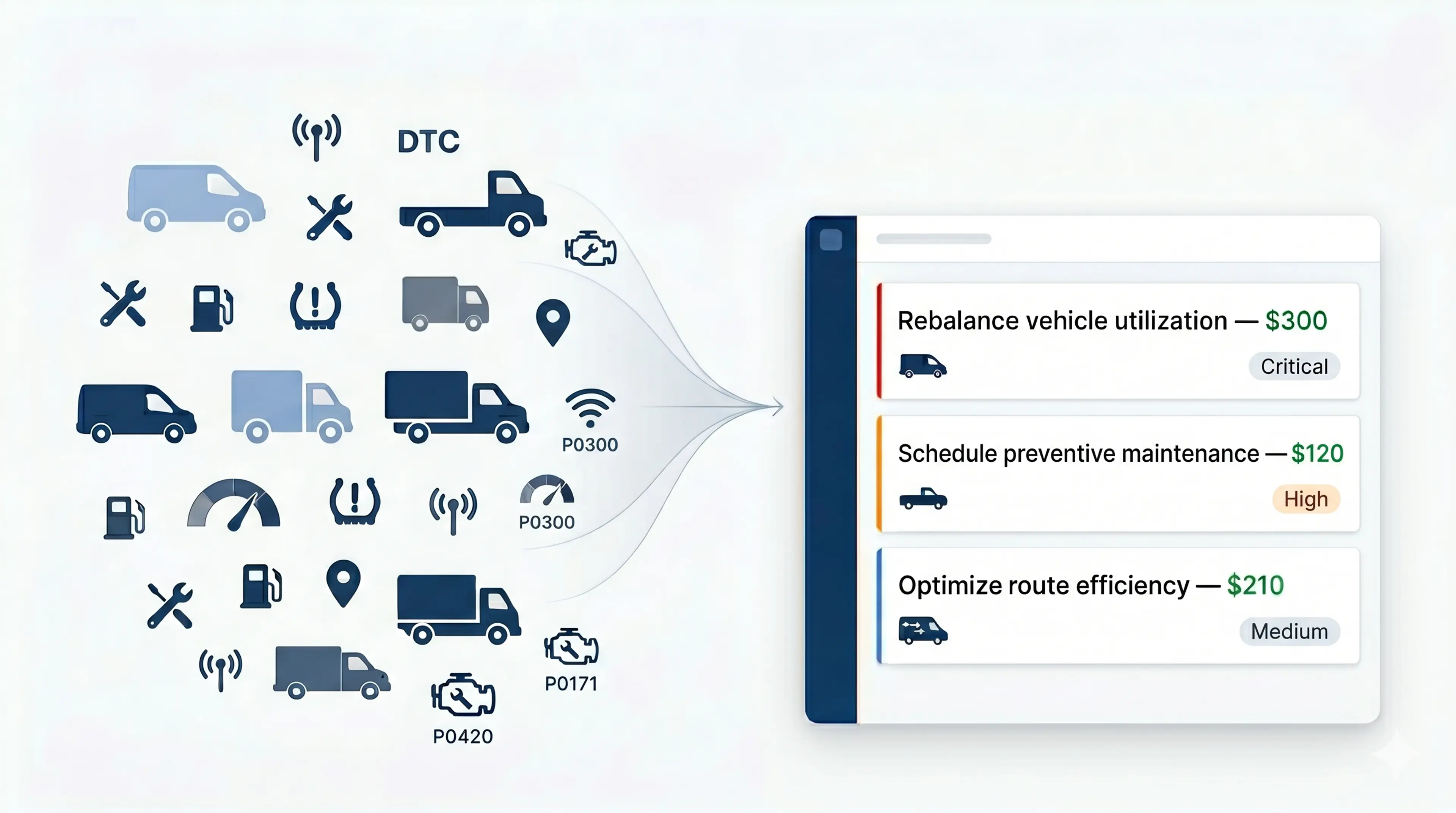
For years, the story in fleet technology has been simple: more visibility leads to better outcomes.
So fleets invested accordingly. Systems expanded. Vehicle connectivity improved. Platforms evolved to bring together signals from across vehicles, operations, and vendors. Today, most large fleets have access to a far more complete picture of what’s happening across their operations than ever before.
And in many ways, that investment worked. Visibility is no longer the problem it once was.
But something else hasn’t kept pace.
Despite having better visibility, many fleet teams still struggle with a basic, everyday question: what should I do right now?
The challenge is no longer seeing what is happening across a fleet. It is understanding what actually matters, what to prioritize, and how to act before costs begin to accumulate. A fleet manager might know that certain vehicles are idling too much, that others are underutilized, or that maintenance is overdue. But translating that awareness into clear, timely decisions still requires time, analysis, and often a fair amount of guesswork.
The Shift to Decision-Making
This is where the next phase of fleet intelligence is starting to take shape.
The industry is moving beyond visibility and insight toward something more valuable: decision-making. Not abstract decision-making, but practical, day-to-day prioritization. What matters most right now? What action will actually improve outcomes? Where should a team focus its attention?
This shift is being driven by the realities of modern fleet operations. Fleets are larger, more complex, and more dynamic than ever. Small inefficiencies, repeated across thousands of vehicles, turn into meaningful cost. And the speed at which those costs accumulate leaves little room for slow or manual analysis.
In this environment, the most valuable systems are not the ones that surface the most information. They are the ones that help teams act on it.
A new layer is starting to emerge on top of connected vehicle intelligence platforms to address exactly this problem. Rather than simply presenting signals, this layer continuously interprets them. It identifies issues as they emerge, evaluates their impact, and brings forward a prioritized set of actions.
The goal is simple: make it easier to decide what to do next.
You can see this shift in how common operational problems are handled. Take excessive idling. Traditionally, addressing it might involve reviewing multiple dashboards, isolating affected vehicles, identifying patterns, estimating impact, and then deciding on a course of action. Each step introduces delay, and during that delay, costs continue to accumulate.
In a decision-oriented model, that process is compressed. The issue is identified, connected to specific vehicles, patterns are surfaced, impact is estimated, and a recommended action is presented. Instead of searching for problems, operators are presented with a clear path to improving outcomes.
Where Motorq Fuse Fits
This is the context in which Motorq Fuse was developed.
Motorq has focused on building a connected vehicle intelligence platform that brings together signals across OEMs and systems to create a consistent operational foundation.
Fuse builds on that foundation by introducing a layer focused on decision-making.
Rather than adding more dashboards, Fuse is designed around a different starting point: what needs attention right now.
At the center of that experience is Action Hub.
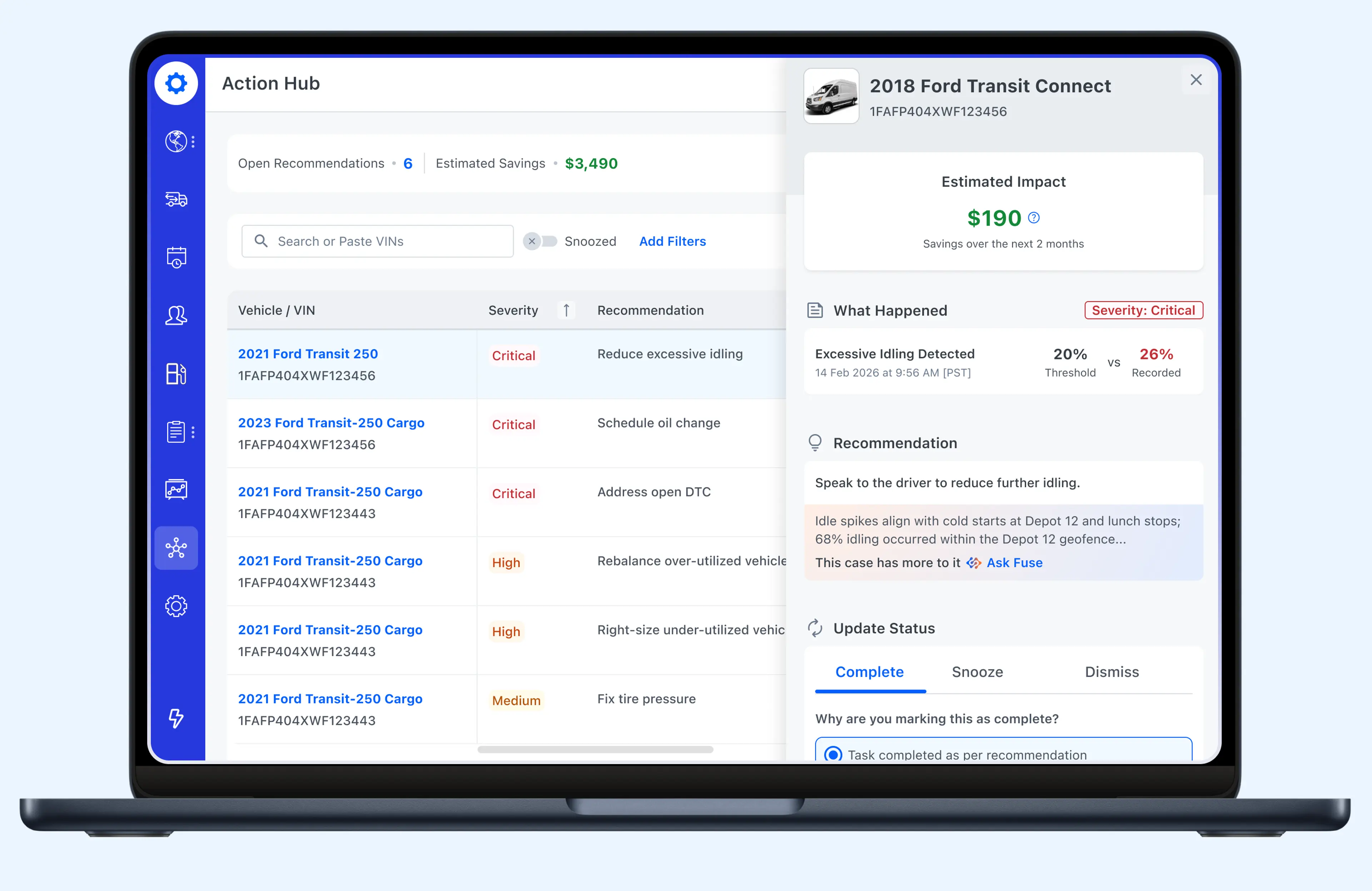
Action Hub surfaces the highest-impact issues across the fleet, with clear recommendations and estimated cost impact for each action.
Action Hub acts as a command center for fleet operations. Instead of navigating across multiple views, operators are presented with a continuously updated list of issues across the fleet, prioritized by severity and estimated financial impact.
Each item is tied to a specific vehicle and includes clear context, along with a recommended action and the expected impact of taking it. This makes it immediately clear not just what is happening, but what is worth acting on.
In the example above, a vehicle has been flagged for excessive idling. The system highlights that it has exceeded the defined threshold, surfaces the severity of the issue, and estimates the potential savings from reducing idle time. It also provides a specific recommendation, in this case addressing driver behavior tied to usage patterns.
Across the full list, teams can see multiple issues ranked side by side, from maintenance risks to underutilized vehicles, each with an associated action and projected impact. With fuel prices and operating costs continuing to rise, this level of prioritization becomes critical. Small inefficiencies like idling, when repeated across a fleet, can quickly turn into meaningful spend.
Instead of starting with analysis, teams start with a clear set of decisions. The focus shifts from reviewing data to acting on the highest-impact opportunities across the fleet.
What This Means Going Forward
Connected Vehicle Intelligence solved the problem of fragmented visibility. The next step is making that intelligence directly actionable in a way that drives better outcomes across the fleet.
That means clearer prioritization and a tighter connection between what is happening and what gets done.
In many ways, the direction is already clear. Systems are starting to move closer to the work itself, not just informing decisions, but helping shape them.
That shift is only just beginning.
Book a demo with the Motorq team. .